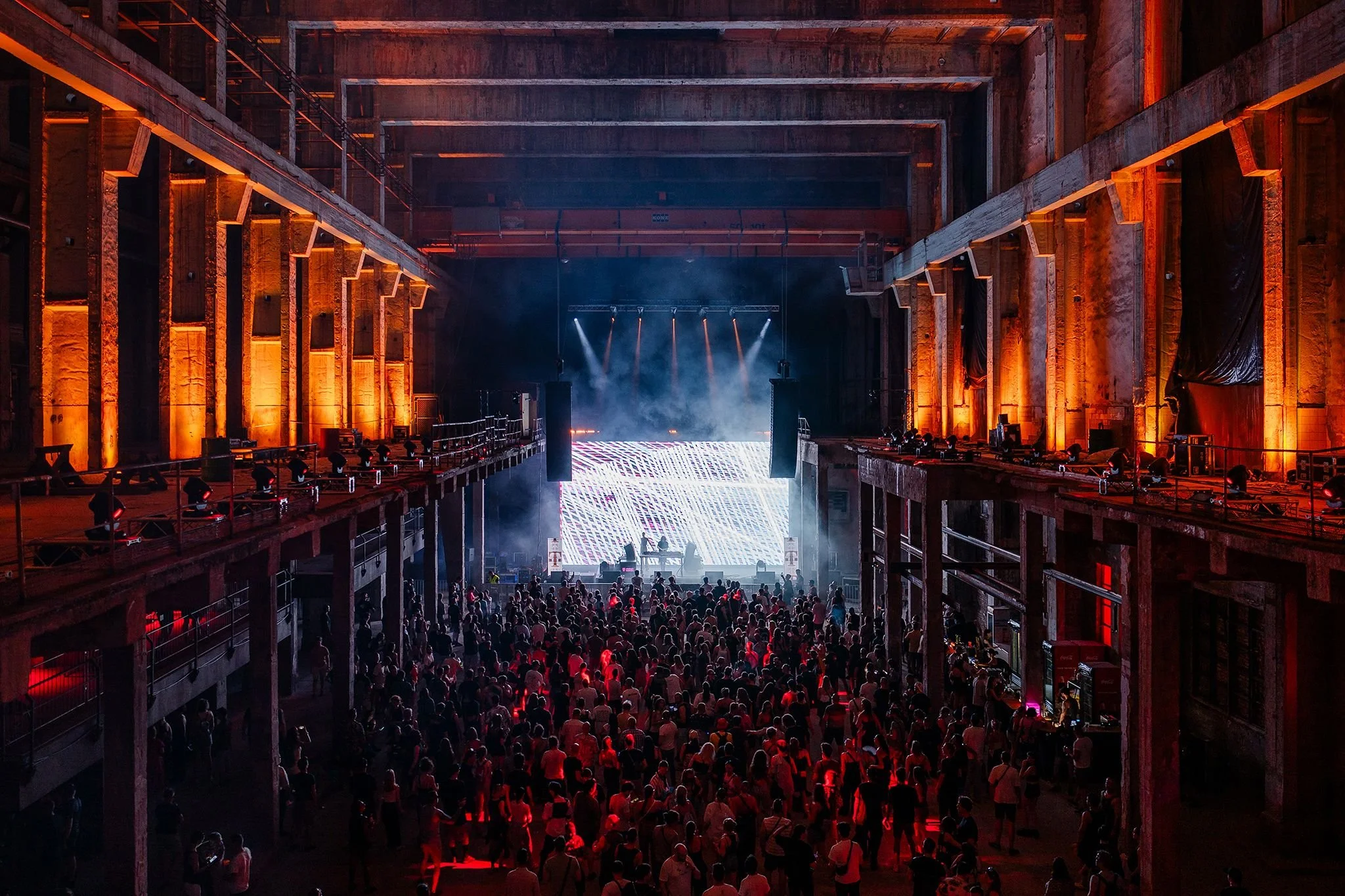


The INOTA Thermal Power Plant was built in the 1950s, when communist Hungary was dreaming of the future in steel, concrete and electricity. Enormous turbines thundered inside its vast glass-brick halls. Outside, three 60-meter cooling towers rose like monuments to the machine age.
Seventy years later, the machines are dead. But the place was deliriously alive.
For three days, another Hungary took over the ruins. Radical art exploded across concrete walls. Techno shook the dead turbines. Bare skin, tattoos, smoke, sweat, strange clothes, beautiful young bodies dancing where machines once roared. Thousands wandered through the carcass of an old dream of the future, inventing another one.
I had come to perform The Human & The Machine: The Last Encounter with my friend, behavioral scientist Tamás Dávid-Barrett. Tamás was the Machine. I was the Human.
His world was hurtling toward us: artificial intelligence, killer robots, synthetic people, infinite computation, perhaps even deathlessness.
My weapons were considerably more primitive: love, touch, memory, belief, creation, mortality, ecstasy. Faces. Stories. Flesh.
A girl in a pink dress running through a rainstorm in the Addis Mercato. A Native American creation myth surviving in a dying language. My mother in Lucknow in 1969, sari fluttering in the wind, cigarette in hand, refusing the life written for her. Cowgirls. Romani singers. Punk artists. Lost princes. Tortured love. Ecstatic release. Longing.
The question wasn't whether machines will become more intelligent than us. They almost certainly will. It was what happens to us when they do.
Machines already make pictures, stories and music in quantities no human culture could absorb. By June, around 90,000 fully AI-generated songs were arriving on Deezer every day—more than half its new uploads. Yet almost nobody was listening.
The machine can make the song. But can it feel the joy or pain of a human voice, the story of the artist, the heat and pulse of the room it was recorded in?
And what happens when machines know us better than we know ourselves, become our companions, preserve our memories—and perhaps even make death optional, leaving us in perpetual childhood?
What becomes of us then?
INOTA itself was once a machine for producing the future, belonging to another Hungary, another political system, another technological dream. Men once walked through those halls absolutely certain they knew what tomorrow looked like.
They didn't.
On April 12, after sixteen years of Viktor Orbán, Hungarians threw his government out and brought Péter Magyar's movement to power, propelled in part by younger voters.
Four months later, I was surrounded by them.
Suddenly INOTA felt like more than festival euphoria. Budapest had felt it too: young, contradictory, restless, sexy, beautiful. A country carrying the weight of its past while something underneath seemed impatient to begin again.
Liberation. Possibility.
The delicious realization that history is never as finished as the people in power would like us to believe. Machines become obsolete. Empires disappear. Governments fall. Gods die. New gods arrive.
And human beings crawl into the ruins, turn up the music and start dancing.
Outside, beneath INOTA’s enormous cooling towers, people were making art, arguing about the future, discovering strange new music, taking photographs, exchanging ideas, kissing. Smoking, drinking, dancing until morning, falling in love with the wrong people and imagining a different Hungary.
There was curiosity everywhere. Openness. Mischief.
Bodies untethered. Minds finally set free. And the exhilarating sense that another way of living might still be possible. The machines were dead. The humans weren't.